
What Is EMI Testing? A Complete Guide to Electromagnetic Interference Testing
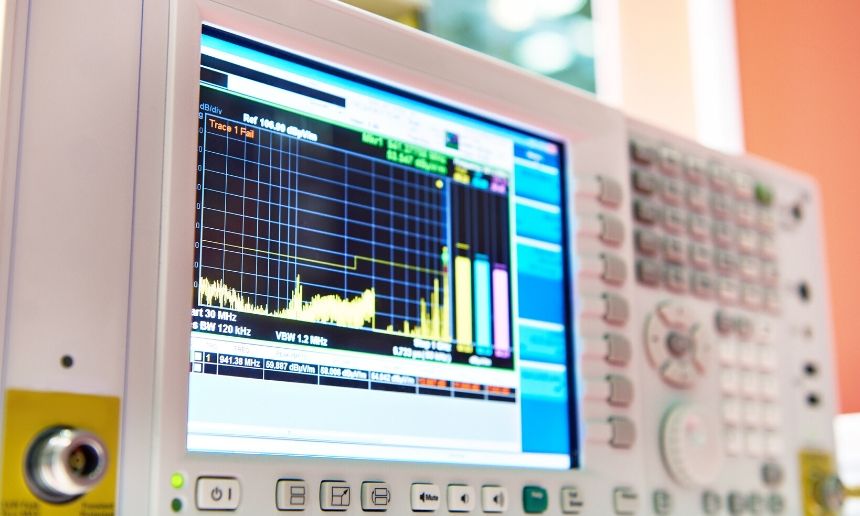
Electromagnetic Interference (EMI) occurs when unwanted electromagnetic energy disrupts electronic devices, circuits, or systems. This interference manifests as noise, signal degradation, data corruption, or complete device failure—threatening reliability across aerospace, medical, automotive, and telecommunications applications.
EMI testing measures how much electromagnetic energy a device emits and how well it withstands external electromagnetic interference. This critical validation ensures electronic products operate reliably in their intended electromagnetic environment while meeting regulatory compliance requirements. Understanding the differences between EMI and EMC helps manufacturers develop compliant products from the start.
Proper shielding design is essential for passing EMI testing—devices with inadequate electromagnetic protection face costly redesigns and delayed market access.
Why EMI Testing is Crucial for Modern Electronics
EMI testing plays a critical role in identifying electromagnetic interference issues before products are deployed in real-world environments, where failures are far more costly and dangerous. By revealing emissions and susceptibility problems early, testing allows engineers to correct design flaws prior to production and field use.
Beyond failure detection, EMI testing helps optimize designs so products are neither over-shielded nor under-shielded, balancing performance, weight, cost, and manufacturability. It also verifies that devices meet stringent regulatory requirements necessary for market access across aerospace, medical, automotive, and telecommunications sectors.
Regulatory mandates make EMI testing non-negotiable:
- FCC Part 15 (US) – Limits unintentional radiators and computing devices
- CE/EMC Directive (EU) – Required for European market access
- IEC 61000 – International electromagnetic compatibility standards
- MIL-STD-461 (Military) – Defense systems emissions and susceptibility
- DO-160 (Aerospace) – Avionics environmental test procedures
Non-compliance consequences include product recalls, market access denial, legal liability, regulatory fines, and long-term reputation damage. The most effective way to prevent field failures is to combine robust EMI shielding with adequate testing during initial design phases.
Radiated Emissions Testing
Radiated emissions testing measures unwanted electromagnetic energy radiating from products into the surrounding space, validating that devices aren’t emitting excessive RF energy that would interfere with nearby electronics.
Test setup requirements:
- Open Area Test Site (OATS) or anechoic chambers
- Measurement antennas at specified distances (3 or 10 meters)
- EMI receivers or spectrum analyzers to capture emissions
Applicable standards: FCC Part 15 (150 kHz – 40 GHz), CISPR 22/32 (information technology equipment), EN 55022/55032 (European harmonized standards).
Effective shielding enclosures reduce radiated emissions at the source, providing 60-90+ dB attenuation and making compliance straightforward (rather than iterative and costly).
Conducted Emissions Testing
Conducted emissions testing measures unwanted electromagnetic energy traveling along power cables and signal lines. While devices may shield radiated emissions effectively, conducted interference propagates through cables and jeopardizes other equipment that shares the power network.
Test setup components:
- LISN (Line Impedance Stabilization Network) – Provides defined impedance blocking external noise
- Spectrum analyzers – Measure emissions 150 kHz to 30 MHz
- Shielded enclosures – Eliminate ambient RF
Vacuum-metallized conductive coatings on plastic enclosures, combined with proper filtering, reduce conducted emissions and improve the odds of passing conducted emissions testing.
Radiated Immunity Testing
Radiated immunity testing simulates real-world RF interference and indicates how powerful external electromagnetic fields will need to be to cause malfunction. Products must operate reliably despite exposure to nearby transmitters, radar systems, and wireless communications.
Required equipment: Signal generators, RF power amplifiers (creating 1-200 V/m field strengths), transmit antennas, and anechoic chambers providing controlled test environments.
Military applications that require passing MIL-STD-461 are tested with field strengths exceeding 200 V/m to simulate high-power radar and jamming scenarios. Comprehensive shielding ensures equipment survives these extreme electromagnetic environments.
Conducted Immunity Testing
Conducted immunity evaluates device resistance to interference injected directly onto power and signal cables. Real-world environments contain electrical fast transients, voltage surges, and RF noise coupled onto cables from external sources.
Test methodologies:
- CDN (Coupling/Decoupling Network) – Injects RF interference onto cables
- Direct RF injection – Applies interference to specific conductors
- Bulk current injection – Uses current probes to inject RF currents into cable bundles
Standards include IEC 61000-4-6 (RF conducted disturbances) and IEC 61000-4-4 (electrical fast transient/burst). Proper grounding and shielding prevent conducted immunity failures.
Key Test Standards and Regulatory Bodies
FCC Part 15 is a United States regulation that governs unintentional radiators—devices using digital circuits that generate RF energy. Class B limits (residential) are approximately 10 dB more stringent than Class A (industrial).
CE Marking requires compliance with EMC Directive (2014/30/EU) and Radio Equipment Directive (RED 2014/53/EU) for European market access. Harmonized standards include EN 55032 (emissions) and EN 55035 (immunity).
MIL-STD-461 specifies electromagnetic emissions and susceptibility for defense systems. Current revision 461G covers conducted emissions (CE101/102), radiated emissions (RE101/102), conducted susceptibility (CS101-118), and radiated susceptibility (RS103/105).
DO-160 (RTCA/DO-160G) establishes environmental test procedures for airborne equipment, including EMC, lightning protection, and HIRF (High-Intensity Radiated Fields) resistance.
Pre-Compliance vs Full Compliance Testing
Pre-compliance testing occurs during development and uses simplified setups to identify potential EMI issues before formal certification. This approach enables design optimization—particularly shielding improvements—and reduces the likelihood of costly failures during final compliance testing.
Benefits: Lower cost, rapid feedback during design iterations, early identification of major shielding deficiencies, reduced risk of compliance failures.
Full compliance testing occurs in accredited laboratories meeting ISO/IEC 17025 requirements. Accredited reports satisfy regulatory authorities and provide legal documentation for market access.
Conduct multiple pre-compliance evaluations throughout development to optimize shielding effectiveness before formal testing. Reserve full compliance testing for production-ready designs with validated electromagnetic protection.
EMI Receivers and Spectrum Analyzers
EMI receivers are specialized instruments designed for compliance testing that meet CISPR 16-1-1 requirements. They provide six standard IF bandwidths, peak/quasi-peak/average detectors per regulatory standards, high dynamic range, and automated scanning.
Spectrum analyzers offer real-time spectrum monitoring and faster measurements but lack quasi-peak detectors required for full compliance. Modern real-time analyzers capture transient emissions missed by swept measurements.
Pre-compliance work uses spectrum analyzers at a lower cost to identify shielding weaknesses. Final compliance requires true EMI receivers or spectrum analyzers with EMI measurement options.
Antennas, LISNs, and Test Facilities
Antennas must cover the required frequency ranges with calibrated antenna factors. Common types: biconical (30-300 MHz), log-periodic (200 MHz – 2 GHz), broadband horn (1-40 GHz).
LISNs provide a defined 50-ohm impedance to devices under test while blocking external conducted noise, enabling repeatable measurements.
Shielded rooms use conductive materials in their walls, thereby turning the entire testing room into a Faraday cage. Anechoic chambers add RF-absorbing foam to eliminate reflections of electromagnetic noise and simulate open-area conditions indoors. Semi-anechoic chambers feature reflective floors with absorber-covered walls and ceilings.
Pre-Compliance Tools for In-House Testing
Budget-friendly setups enable rapid design iteration and shielding validation. USB spectrum analyzers ($1,000-$5,000) identify major EMI issues and shielding deficiencies during development.
Near-field probes ($200-$2,000) enable PCB-level troubleshooting by identifying specific noise sources on circuit boards. These magnetic and electric field probes pinpoint problematic components or traces that require localized shielding.
Software like EMCVu provides simplified automated testing. Pre-compliance doesn’t require accredited calibrations or full anechoic chambers—tabletop shielding and basic antenna sets suffice for validating shielding improvements.
Aerospace & Defense EMI Testing
Military and aerospace systems face intentional high-power electromagnetic threats. MIL-STD-461 validates equipment survivability in contested environments that may concern jamming, radar, and nuclear electromagnetic pulses (NEMP). Shielding effectiveness requirements may exceed 100 dB of attenuation for mission-critical electronics.
DO-160 Section 22 addresses lightning-induced transient susceptibility. Aircraft must withstand direct and indirect lightning strikes without critical failures—this requires comprehensive enclosure shielding.
HIRF testing exposes equipment to field strengths exceeding 7,200 V/m, simulating proximity to ground-based radar during airport operations. Only properly shielded equipment survives these extreme field intensities.
Medical Device EMI Requirements
IEC 60601-1-2 establishes EMC requirements for medical electrical equipment. The standard specifies immunity levels based on electromagnetic environments—professional healthcare facilities versus home healthcare settings.
Low EMI tolerance in operating rooms and intensive care units demands robust shielding to mitigate interference from RF-generating surgical equipment, MRI systems, and wireless communications. Inadequate shielding causes life-threatening malfunctions in patient monitoring and treatment delivery systems.
Automotive & Consumer Electronics Testing
CISPR 25 establishes vehicle component emissions and immunity limits. Testing validates that infotainment systems, ADAS sensors, powertrain controllers, and body electronics maintain electromagnetic compatibility through comprehensive shielding.
ISO 7637 addresses electrical transients on power supply lines. Voltage spikes from load dumps, switching transients, and inductive coupling must not disrupt vehicle electronics.
Modern vehicles integrate dozens of electronic systems that create electromagnetically dense environments. Hybrid and electric vehicles add high-power inverters and wireless charging, both of which generate strong electromagnetic fields that require robust EMI testing methods to verify roadworthiness.
Design for EMC from the Start
Early EMC consideration dramatically reduces testing failures and redesign costs. PCB layout fundamentals:
- Solid ground planes providing low-impedance return paths
- Minimized loop areas, reducing magnetic field coupling
- Strategic component placement separating noisy and sensitive circuits
- Controlled impedance traces for high-speed signals
Proper tips for reducing EMI in PCB designs implement these strategies during initial development rather than after testing failures.
Shielding enclosures are critical: Vacuum-metallized conductive coatings on thermoformed plastics provide lightweight electromagnetic protection with 60-90+ dB effectiveness. Understanding how to measure EMI shielding effectiveness empowers you to validate design decisions before formal testing.
Pre-Testing Checklist
Standards selection – Identify applicable regulations for target markets (FCC, CE, military, industry-specific)
Equipment calibration – Verify test instruments maintain valid calibrations traceable to national standards
Shielding validation – Confirm enclosure shielding effectiveness meets design targets through pre-compliance measurements
Device preparation – Ensure representative production configuration – including final enclosures, cables, and accessories – is used in the test.
Common mistakes to avoid:
- Testing development prototypes without production-equivalent shielding
- Inadequate cable management that results in unintentional antennas
- Missing required operating modes during immunity testing
- Insufficient enclosure shielding that allows electromagnetic fields to penetrate the device
What Happens If You Fail EMI Testing?
EMI test failures are common during initial compliance attempts when shielding proves inadequate. Diagnostic methods:
- Near-field scanning localizes emission sources that require enhanced shielding
- Frequency analysis correlates emissions to clock frequencies or switching regulators
- Time-domain analysis captures transient emissions
Iterative troubleshooting:
- Identify dominant emission frequencies and leakage paths
- Correlate frequencies to circuit functions and enclosure openings
- Implement targeted fixes—enhanced shielding, improved gaskets, better grounding
- Retest verifying shielding improvements
- Address remaining issues until full compliance is achieved
Common design revisions: Enhanced enclosure shielding effectiveness, improved conductive gaskets to seal joints, additional localized shielding over high-emission components, PCB layout modifications to improve grounding.
Choosing the Right EMI Testing Partner
Accredited laboratories hold ISO/IEC 17025 accreditation from recognized bodies (A2LA, NVLAP). Accreditation verifies that laboratories maintain qualified personnel, calibrated equipment, and documented quality systems.
Key selection criteria:
- Accreditation scope covering the required standards
- Industry-specific expertise (aerospace, medical, automotive)
- Chamber capabilities match device size and frequency ranges
- Engineering support for troubleshooting and shielding recommendations
Shielding preparation: Before engaging test labs, validate shielding effectiveness through pre-compliance testing. Well-shielded products pass compliance testing on first attempts, avoiding expensive retest cycles.
What is the Difference Between EMI and EMC?
EMI (Electromagnetic Interference) refers to unwanted electromagnetic energy that may disrupt device operation. EMC (Electromagnetic Compatibility) encompasses both emissions control and immunity—the complete ability of equipment to function properly without causing or experiencing interference.
EMC includes emissions testing (ensuring devices don’t generate excessive EMI through proper shielding) and immunity testing (verifying devices withstand external EMI through adequate protection).
How Long Does EMI Testing Take?
Full compliance testing typically requires 3-5 days for straightforward products with effective shielding. Complex devices with multiple configurations may require 1-2 weeks.
Testing duration depends on: number of required standards, device complexity, configuration options, number of ports requiring testing, and frequency of failures that require shielding modifications to be developed and additional testing to occur.
Well-shielded products pass initial testing quickly. Poorly-shielded products face multiple retest cycles, dramatically extending timelines and costs.
Can EMI Be Eliminated Completely?
Complete EMI elimination is impossible—all electronic circuits generate some electromagnetic energy. However, proper shielding design reduces emissions to negligible levels that meet regulatory limits with a substantial margin.
Multi-faceted approaches combining good PCB layout, comprehensive filtering, and effective enclosure shielding achieve excellent EMI attenuation. Vacuum-metallized conductive coatings on plastic enclosures provide 60-90+ dB shielding effectiveness—reducing emissions to tiny fractions of regulatory limits and ensuring straightforward compliance testing.
What’s the Cost Range for EMI Testing?
Full compliance testing costs:
- Simple products: $3,000-$8,000
- Moderate complexity: $8,000-$15,000
- Complex products: $15,000-$50,000+
Pre-compliance testing runs $500-$2,000 per day. In-house pre-compliance capabilities cost $10,000-$50,000 for basic equipment.
However, the biggest cost isn’t testing—it’s failure. Products with inadequate shielding fail testing, requiring expensive redesigns, new shielding tooling, and multiple retest cycles. Each retest cycle costs $3,000-$15,000 plus weeks of schedule delay.
Investment in proper shielding design and pre-compliance validation dramatically reduces expensive compliance test failures.
Prepare Your Products for EMI Testing Success
Deep Coat Industries provides custom EMI shielding solutions to help manufacturers pass EMI testing on first attempts. Our vacuum-metallized conductive coatings deliver 60-90+ dB shielding effectiveness on thermoformed plastic enclosures, injection molded housings, and 3D printed components—providing lightweight electromagnetic protection that meets the most stringent regulatory requirements across aerospace, defense, medical, and commercial electronics.
With over 45 years of electromagnetic shielding expertise, we help product developers design effective enclosure shielding before compliance testing begins. Our dual-fire and quad-fire vacuum metallizing processes create multi-layer conductive coatings optimized for specific frequency ranges, which reduces the costly design-test-fail-redesign cycle plaguing products with inadequate electromagnetic protection.
Contact Deep Coat Industries for shielding design consultation before your compliance testing. Our engineering team provides material recommendations, shielding effectiveness predictions, and custom coating solutions, ensuring your products achieve electromagnetic compatibility requirements—passing EMI testing the first time and reaching market faster.